
Who plays crash games? The profile in figures
For press and research
The crash-game player does not look like the traditional casino player. Younger, mobile-first, longer sessions than on slot machines, and automatic cashouts concentrated on small multipliers: here is their identikit in sourced figures.
- The core audience is 24–38 — a generation younger than the classic casino.
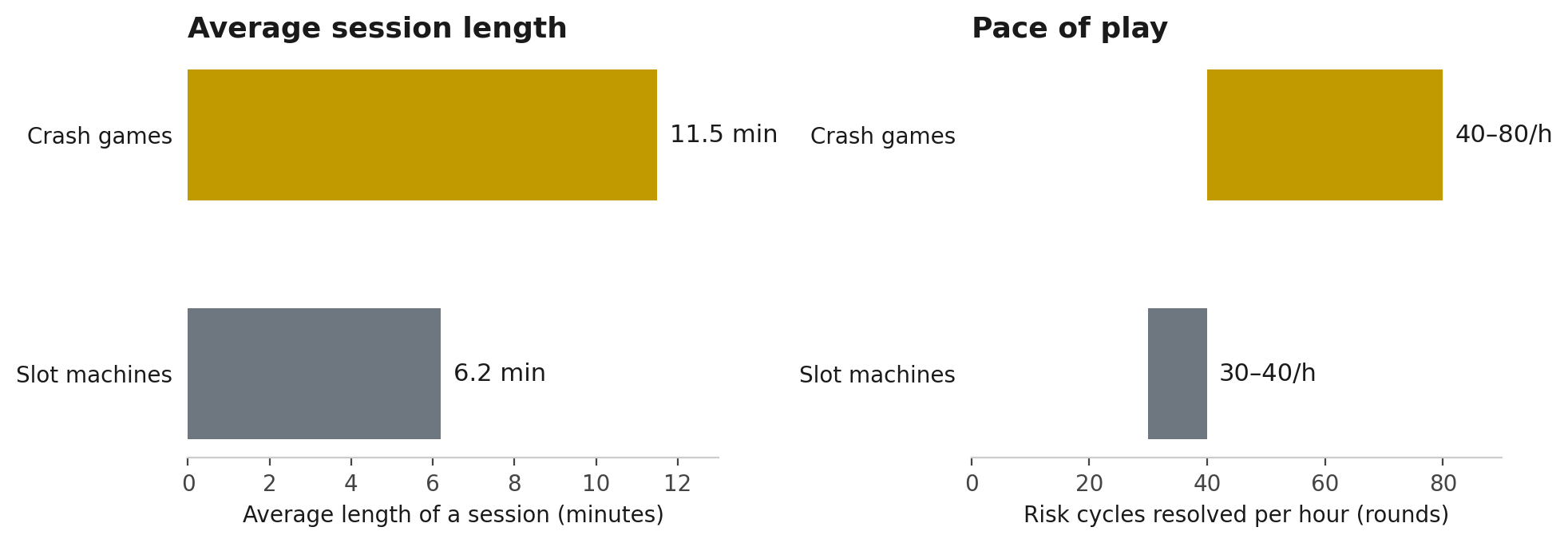
- Sessions of 11.5 minutes on average, almost double those of slot machines.
- An intense pace of play: 40 to 80 resolved risk cycles per hour.
- Gen Z as the engine: 72% prefer multiplayer and interactive formats.
Key figures
24–38 years — the crash-games core audience according to operator data.[1]
Source: G-M News, September 2026.
34.1% — the share of 25–34-year-olds among the world's online gamblers in 2025; it is also the segment where crash-game demand is rising fastest.[2][3]
Sources: Mordor Intelligence, 2026; Slotegrator via Asia Gaming Brief, January 2024.
~12% — the annual growth of 18–24-year-olds, the fastest-growing age segment in online gambling.[2]
Source: Mordor Intelligence, 2026.
72% — the share of Gen Z who prefer multiplayer and interactive formats to solitary betting — the social engine of crash-game growth.[4]
Source: Virlan, September 2026.
69% — the share of Gen Z who gamble online (68% for Millennials).[5]
Source: iwantmedia.
11.5 minutes — the average length of a crash-game session, against 6.2 minutes on slot machines.[1]
Source: G-M News, September 2026.
+35 to +50% — the session lengthening of players who migrate from slots to crash games.[6]
Source: Retail Focus, April 2026.
40–80 — the risk cycles resolved per hour on a crash game, against 30–40 on slots.[6] This speed matters: event frequency is one of the two strongest structural predictors of the number of bets per session, in tracking data from 43,731 players.[7]
Source: Retail Focus, April 2026.

~50–55% — the share of Aviator rounds that crash below 2.0x; only ~1% reach 100x (theoretical distribution derived from the 97% RTP).[8]
Source: Ibets.co.za, from the RTP published by Spribe.
8–30 seconds — the length of an Aviator round, plus ~5 seconds between rounds.[9]
Source: Betway Kenya.
$0.10–$100 — the per-round stake range recorded on a reference title (Speed Crash, Hacksaw Gaming); it varies by game, operator and country.[10]
Source: CrashGambler.
+35% — the maximum increase in stakes observed when a cash-out option is available, under experimental conditions (laboratory task, sports-betting format — this is not a measurement taken on crash games).[11]
Source: Bennett et al., Psychological Science, 2024.
Cashouts concentrated at the bottom of the scale — in the logs of a crash game analyzed by researchers, the auto-cashout multipliers chosen by players concentrate on low values, with a long tail of high targets.[12]
Source: Wang & Pleimling, Scientific Reports, 2019.
51.8% — the share of live sports bettors reporting they have already used the cash-out function (survey conducted in Ontario; live sports betting, not specifically crash games): the first academic measurement of cash-out use.[13]
Source: Sinclair et al., Addictive Behaviors, 2024.
Our analysis: what this page's figures say to each other
Everything above comes from the cited sources. What follows is our analysis, and it mixes three things that we distinguish at every step: the sources' findings, credited to them and cited; our calculations on their published figures, flagged as ours, with their margins; and our interpretations, labelled as such.
A crash session holds roughly eight to fifteen decisions. This page's sources separately give a session length (11.5 minutes) and a pace (40 to 80 resolved risk cycles per hour). Composing them — 11.5 ÷ 60 × 40 ≈ 7.7; 11.5 ÷ 60 × 80 ≈ 15.3, our calculation — an average session contains about 8 to 15 rounds. The same computation on slot machines gives 3 to 4 rounds per session (6.2 ÷ 60 × 30 ≈ 3.1; 6.2 ÷ 60 × 40 ≈ 4.1). Our reading: the gap between the two formats lies both in how long sessions last and in how many resolved decisions they contain — the two gaps multiply rather than add up. These figures come from different sources — operator data relayed by G-M News for session lengths, Retail Focus for pace — and describe audiences that are not the same; we compose them as an order of magnitude, not as a measurement on a single sample.[1][6]
The hourly pace and the round length do not add up to continuous play. A pace of 40 to 80 cycles per hour implies one full cycle every 45 to 90 seconds (3,600 ÷ 80; 3,600 ÷ 40, our calculation). Yet an Aviator round lasts 8 to 30 seconds, plus about 5 seconds between rounds — a cycle of 13 to 35 seconds, enough to chain 103 to 277 rounds per hour in continuous play (3,600 ÷ 35; 3,600 ÷ 13), far above the published 40 to 80 cycles. The two series cover neither the same game nor the same source — Aviator at Betway Kenya on one side, crash games in general at Retail Focus on the other — and we do not merge them. Our reading: their gap states something neither of them says: the aggregate pace necessarily includes time outside rounds — rounds watched without betting, pauses, game switches — and does not describe a player betting on every round.[6][9]
The two Aviator distribution figures are really one. From the 97% RTP published by Spribe, this page cites roughly 50 to 55% of rounds crashing below 2.0x and roughly 1% reaching 100x. We checked that a single formula produces both: in the theoretical distribution of a crash game, the probability of reaching a multiplier m is 0.97 ÷ m. It gives 48.5% for 2.0x — hence 51.5% of rounds below 2.0x, inside the published range — 9.7% for 10x, about one round in ten, and 0.97% for 100x, the page's "roughly 1%". The median multiplier that follows is 1.94x (0.97 ÷ 0.5, our calculation): the typical round stops before 2.0x. Our reading: cashing out at 2.0x means aiming at a threshold most rounds never reach — and the concentration of auto-cashouts on small multipliers, observed in the game logs analyzed by Wang & Pleimling, is consistent with that geometry.[8][12]
The Gen Z engine is a format engine, not a participation engine. Two neighbouring figures on this page say less than they seem to: 69% of Gen Z gamble online, against 68% of Millennials — a one-point gap (our calculation), which is participation parity. The generational gap sits elsewhere: in the 72% of Gen Z who prefer multiplayer and interactive formats. These two figures come from two different sources and from audiences that do not exactly overlap — Gen Z in general at iWantMedia, Gen Z gamers at Virlan — and we set them side by side as a reading, not as a measurement on a single sample. Our reading: crash games do not recruit a generation that gambles more; they capture a generation that gambles just as much, but prefers to play surrounded.[5][4]
Our other crash game statistics
- Discover your player profile — our 2-minute quiz
- Understanding crash-game mechanics
- Is Chicken Road 2 legit? — the honest answer
How to read this page: this is independent analysis, published for information. It does not recommend buying, using or avoiding any product, and it is not financial advice. Every figure is computed from data published with this study or from the operator's published terms. We are funded by affiliate commissions disclosed on this site; no operator reviewed or approved this analysis before publication.
References
- G-M News, "Why Crash Games Are Basically Rewriting Online Betting", September 2026, https://g-mnews.com/en/why-crash-games-are-basically-rewriting-online-betting/ ↑
- Mordor Intelligence, report on the global online gambling market, 2026, via CasinoNewsDaily, 12 February 2026, https://www.casinonewsdaily.com/blog/2026/02/12/mordor-gambling-report-shows-why-some-numbers-see-more-attention/ ↑
- Slotegrator, developer survey, via Asia Gaming Brief, 10 January 2024, https://agbrief.com/news/world/10/01/2024/75-of-game-developers-respond-to-rising-demand-for-crash-games-says-slotegrator/ ↑
- Virlan, "Crash Games vs Slots 2026: Gen Z iGaming Trends", 12 September 2026, https://www.virlan.co/casino/crash-games-vs-slots-2026-gen-z-igaming-trends/ ↑
- iWantMedia, "The Gambling Preferences of Generation Z", https://iwantmedia.com/the-gambling-preferences-of-generation-z/ ↑
- Retail Focus, "Crash games rewrite online gambling", 9 April 2026, https://retail-focus.co.uk/crash-games-rewrite-online-gambling/ ↑
- Auer, M. & Griffiths, M.D., « The relationship between structural characteristics and gambling behaviour: An online gambling player tracking study », Journal of Gambling Studies, 2022, https://doi.org/10.1007/s10899-022-10115-9 ↑
- Ibets.co.za, Aviator guide (distribution presented from the 97% RTP published by Spribe), http://ibets.co.za/guides-and-tips/guide-aviator-spribe-tips-strategies-how-to-play/ ↑
- Betway Kenya, Aviator page, https://betway-kenya.com/aviator.html ↑
- CrashGambler, "Speed Crash by Hacksaw Gaming", https://crashgambler.io/speed-crash-by-hacksaw-gaming/ ↑
- Bennett, D. et al., « People Place Larger Bets When Risky Choices Provide a Postbet Option to Cash Out », Psychological Science, 2024, https://doi.org/10.1177/09567976241266516 ↑
- Wang, X. & Pleimling, M., « Online Gambling of Pure Chance: Wager Distribution, Risk Attitude, and Anomalous Diffusion », Scientific Reports 9, 2019, https://doi.org/10.1038/s41598-019-50168-2 ↑
- Sinclair, E.S.L. et al., « Cash outs during in-play sports betting: Who, why, and what it reveals », Addictive Behaviors 155:108008, 2024, https://doi.org/10.1016/j.addbeh.2024.108008 ↑
Full dataset: this page's key figures (20 rows: value, source and year for each), in CSV format — the exact table every figure published here is drawn from. Download the CSV
Free to reuse in press and research, with attribution: "Source: Chicken Road Productions, 'Who plays crash games? The profile in figures', 2026" — https://chickenroadproductions.com/en/crash-game-player-statistics/
Citing these figures? The editors reply via the Press page.